Ukrainian intelligence details Kinzhal missile, lists 58 Russian suppliers
Ukraine's military intelligence says 22 of 58 Russian firms involved in making the Kh-47M2 Kinzhal are not under any sanctions. It also claims Russia cut Kinzhal orders in 2026 in favour of Iskander-M missiles.
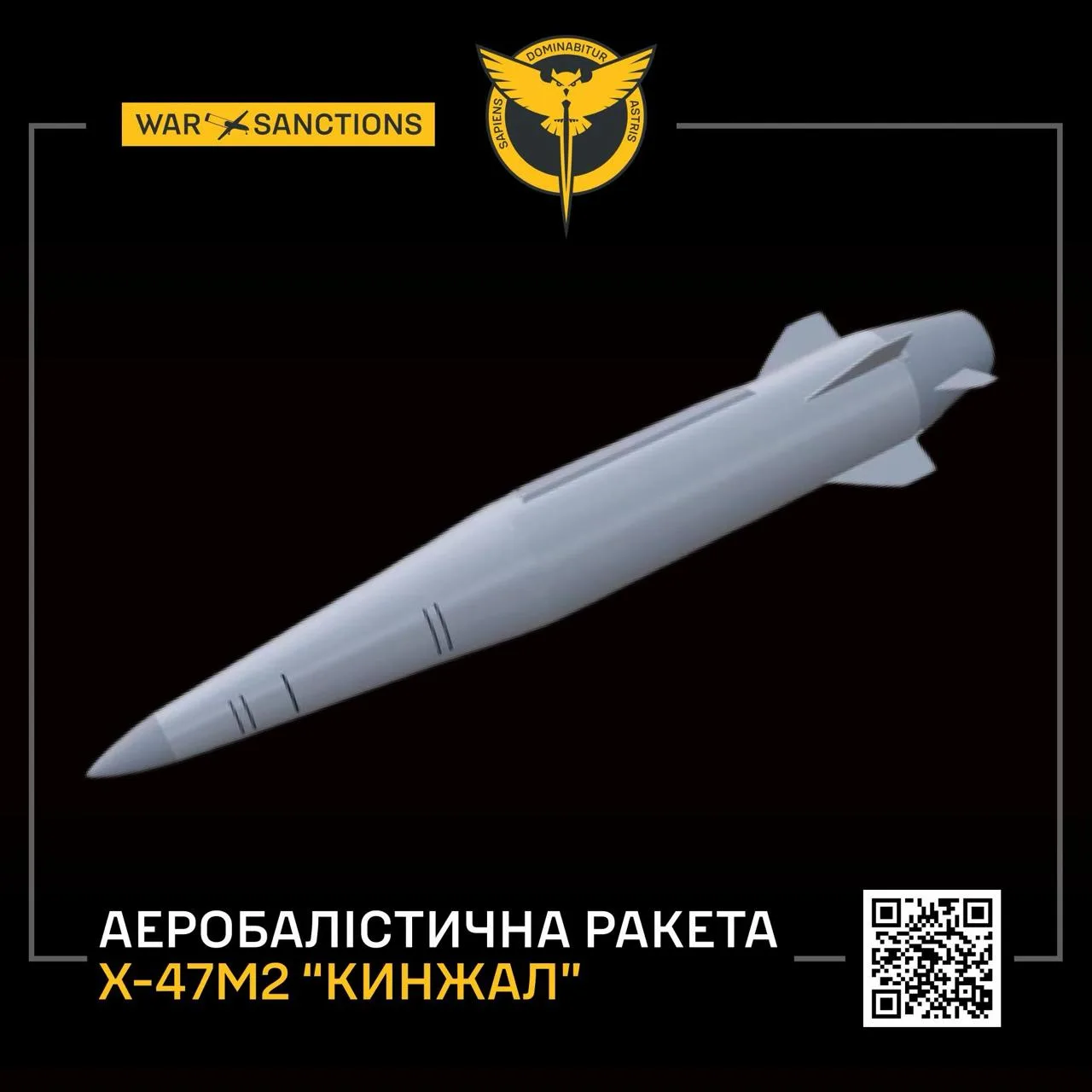
Ukraine's Defence Intelligence Directorate (HUR) has published technical details of Russia's Kinzhal air-launched ballistic missile, together with data on 58 Russian enterprises it says are involved in producing it. HUR says 22 of those firms are still not under sanctions from any country in the sanctions coalition.
The agency announced the release on 12 October on its Telegram channel. The material is on its War&Sanctions portal and includes an interactive 3D model of the missile, a breakdown of its components and a list of cooperating enterprises. All the claims below come from HUR and have not been independently verified.
What HUR says about the missile
HUR identifies the Kinzhal by its index 9-S-7760, also known as the Kh-47M2. It describes it as a single-stage, solid-fuel missile with an integrated warhead. According to HUR, about 90% of its components are shared with the 9M723 ballistic missile used in the Iskander-M system.
HUR lists these main differences from the Iskander:
- a tail aerodynamic fairing that separates after the motor starts;
- an active radar homing seeker, which Russia calls "all-weather";
- an active jamming station, in addition to the S-200 system that ejects decoy targets.
HUR says an active radar seeker exists on the Iskander only "on paper" for now. It says the use of such a seeker in strikes on Ukrainian territory has not been recorded.
Warheads and accuracy
The Kinzhal has two types of warhead, according to HUR. One is a penetrating high-explosive warhead in a thick metal casing, designed to break through floors, concrete and hardened structures. The other is a special (nuclear) warhead.
HUR says Russia is now working on a variant with a fragmentation-high-explosive warhead. It suggests this change may be directly linked to problems with the missile's guidance accuracy. High accuracy matters most for a penetrating warhead, it says.
Reduced orders, ageing carriers
HUR says that for this reason Russia significantly reduced the volume of its state defence order for Kinzhals in 2026. It claims production capacity, components and raw materials were redirected to making Iskander-M missiles. HUR did not publish figures for the reduction in the post.
It names a second reason for the priority shift: the limited service life of the missile's carrier aircraft. These are the MiG-31I interceptors and their predecessor, the MiG-31K, which HUR says Russian industry is not currently building. HUR said it will soon publish a list of Russian enterprises that modernise and service the MiG aircraft.
Call for sanctions
HUR says Russia continues to modernise the Kinzhal despite what it calls individual shortcomings. To counter this, it calls for sanctions to be synchronised against all the enterprises involved. It also calls for tighter control of the technologies Russia is using.
The post does not name the 58 enterprises. It says their data is available on the War&Sanctions portal. HUR did not say which countries make up the sanctions coalition or which firms are unsanctioned. RealUA has not reviewed the portal's list independently.