Russia launches 193 drones overnight; Ukraine downs or suppresses 154
Ukraine's General Staff says Russia attacked with 193 drones overnight into 2 November, 75 of them jet-powered Shaheds. Air defence downed or suppressed 154. Separately, HUR published details of the enlarged Gerbera-2 drone.
Russia attacked Ukraine with 193 strike drones overnight into 2 November, and air defence downed or suppressed 154 of them by 08:00, Ukraine's General Staff said. Damage and casualties were not specified in the report.
What the General Staff reported
The attack ran from 18:00 on 1 November. According to the General Staff, the drones were Shahed-type strike drones (75 of them jet-powered), Gerbera drones and Parodiya decoy drones. They were launched from the directions of Oryol, Kursk and Bryansk in Russia, from Russian-occupied parts of the Donetsk region, and from Hvardiiske in occupied Crimea.
Aircraft, anti-aircraft missile troops, electronic warfare units, unmanned-systems units and mobile fire groups took part in repelling the attack, the General Staff said.
Preliminary data as of 08:00 showed 154 drones downed or suppressed. These included Shahed-type drones (58 of them jet-powered), Gerbera drones and other types. "Suppressed" generally refers to drones diverted or disabled by electronic warfare rather than shot down. The General Staff said more than six strike drones were still in the air and that "combat work continues".
Enemy attack weapons hit 26 locations, and debris from downed drones fell on nine locations. The report did not say which regions were affected or whether anyone was killed or wounded. The figures are preliminary and could not be independently verified.
HUR details the Gerbera-2
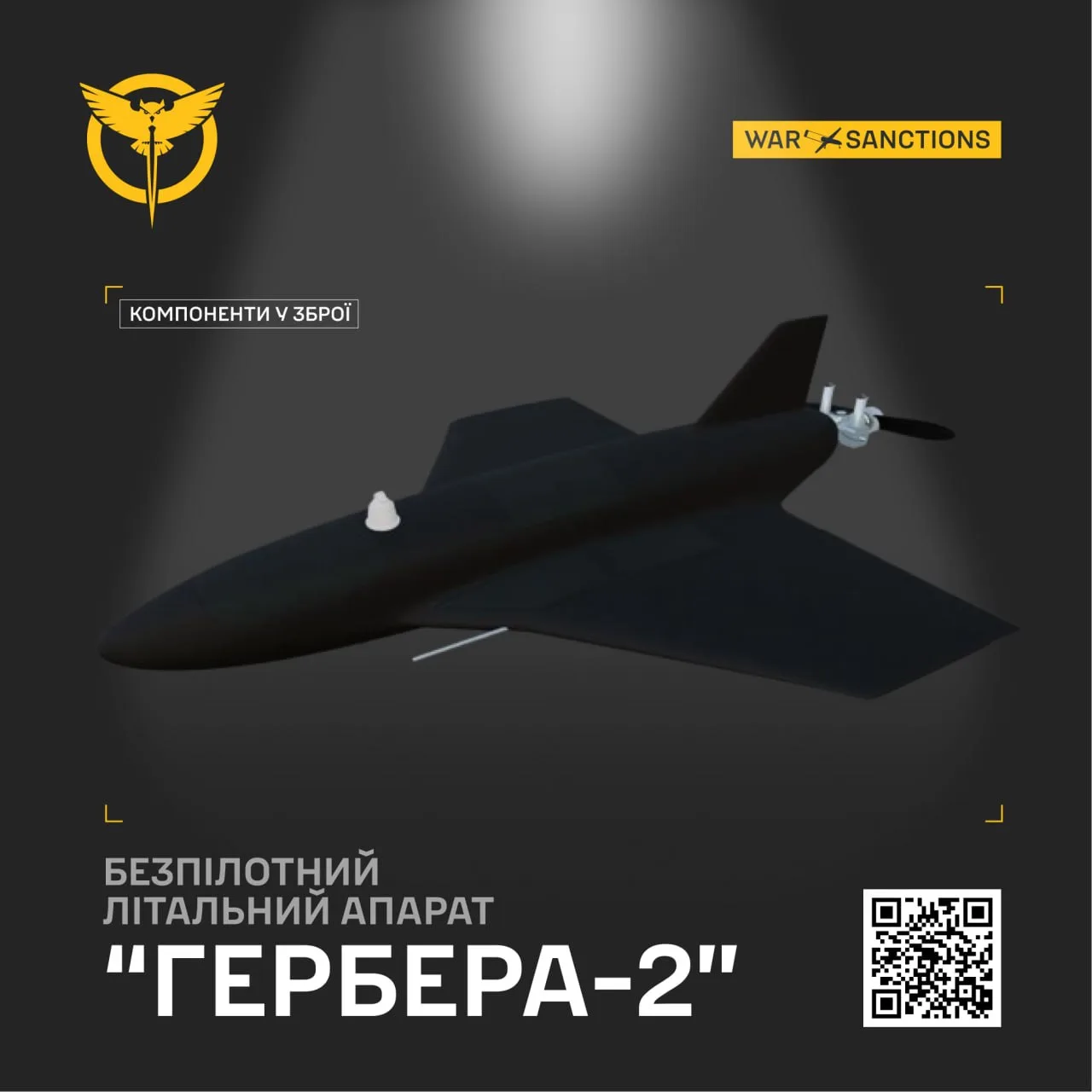
In a separate announcement, Ukraine's military intelligence service (HUR) said Russia is using a larger, longer-range version of the Gerbera drone. HUR published an interactive 3D model and component data for the "Gerbera-2" on its War&Sanctions portal.
According to HUR, Gerbera drones were first developed as decoys to overload air defences. Early versions had "Reconnaissance" and "Kamikaze" modifications but remained relatively simple and cheap. Over time, their internals moved closer to those of the far more expensive Geran (Shahed) drones, with Kometa satellite-navigation modules, mesh modems and costly gimbal-mounted cameras.
HUR said the new version has a wingspan of 3 metres and a fuselage length of 2.6 metres. A 63-litre fuel tank, divided into sections to keep the aircraft stable in manoeuvres, gives it a range of up to 1,200 km, according to HUR. The two-cylinder, two-stroke engine is effectively half of the Geran-2 engine, whose production was localised in Alabuga, the intelligence agency said.
The examined sample carried a 10 kg OFZBCh-10 high-explosive fragmentation incendiary warhead and separate bags of incendiary mixture. HUR said that, by the enemy's stated characteristics, the drone can carry a warhead of up to 25 kg.
On electronics, HUR listed an updated flight controller, a 12-channel Kometa, a mesh modem made by Shenzhen Sinosun Technology Co., Ltd (China) and a new video-processing unit called "Sosiska", built on a Chinese Coke Pi microcomputer. The sample had a dual IP camera mounted above the fuel tank, intended to detect interceptors. HUR also found versions with forward-facing IP cameras and with three-axis gimbal cameras. Most foreign-made components came from Chinese (8) and American (4) manufacturers, it said.
Why the range matters
HUR said the extended range suggests the drone's area of use could go beyond Ukraine. It said a Gerbera-2 with a warhead was found in mid-September on the Baltic coast of Poland. HUR did not give further details of that find in this post, and RealUA has not independently verified the claim.
Background
Russia has increasingly mixed cheap decoys and jet-powered Shaheds into its raids. RealUA reported earlier that the General Staff said Russia used 2,597 Shahed, Parodiya and Gerbera drones over seven days to 24 October, of which Ukrainian forces neutralised 2,282, or more than 87%. The figures are official and unverified. Ukraine has also been working to counter the faster jet-powered variants, with interceptor drones and F-16 cannon rounds supplied by Denmark.