Exports' share of Ukraine's GDP halves to 25% as EU becomes main market
Exports of goods and services fell from about 50% of Ukraine's GDP in the early 2010s to 25% in 2025, the Centre for Economic Strategy says. The EU now takes 55–60% of goods exports, and farm products make up about 60%.
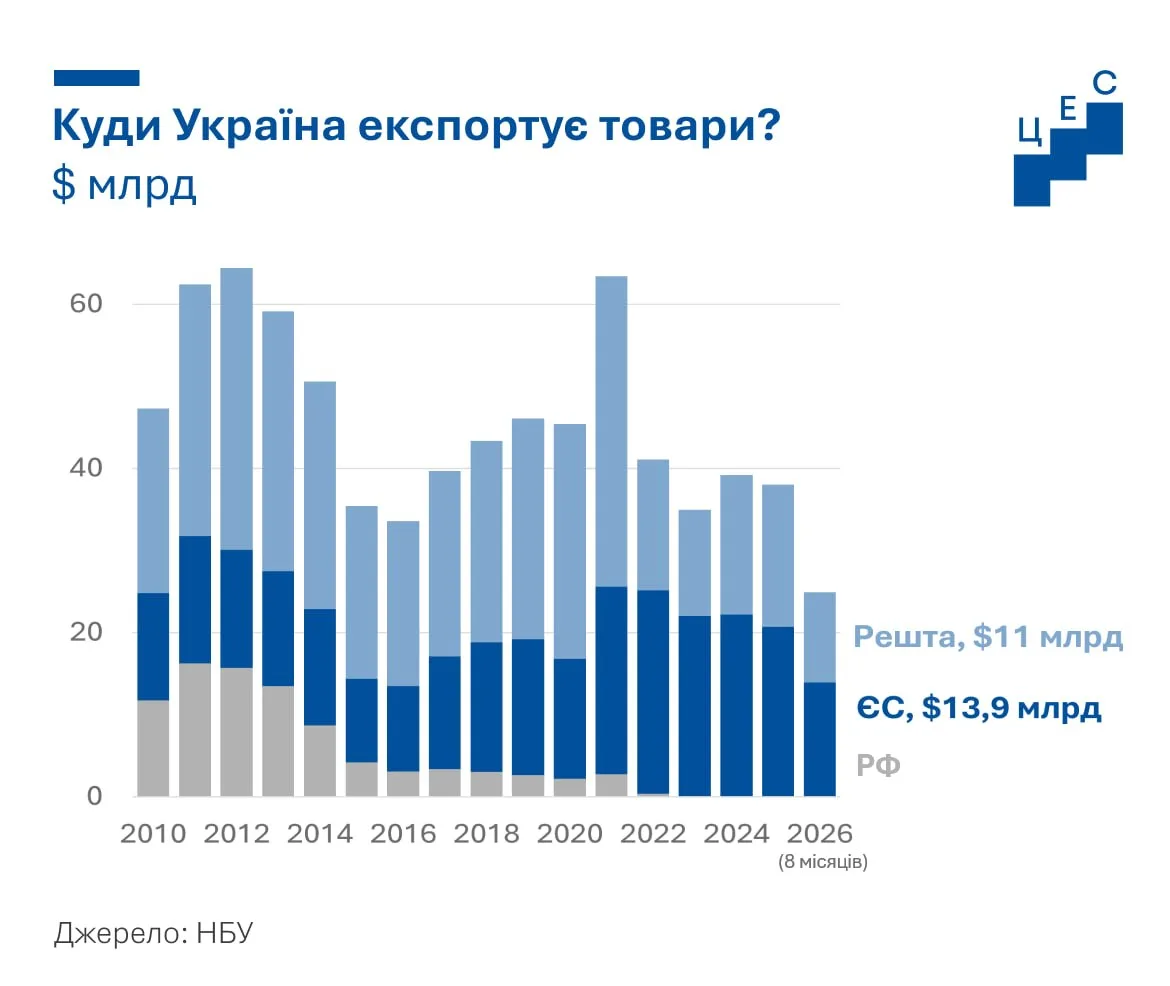
Exports of goods and services have shrunk from about 50% of Ukraine's GDP in the early 2010s to 25% in 2025, according to the Centre for Economic Strategy (CES), a Kyiv think tank. The European Union has meanwhile replaced Russia as Ukraine's main trading partner, and farm products have overtaken metals as the leading export.
CES director Hlib Vyshlinskyi presented the figures at an export forum organised by the outlet Ekonomichna Pravda. The think tank summarised the findings on its Telegram channel on 23 October.
War hit exports twice
CES says war has twice caused exports to collapse. After Russia's occupation of Crimea and part of Donbas, exports fell by almost half between 2012 and 2016. At the start of the full-scale invasion in 2022, they nearly stopped altogether.
Sea shipments recovered first thanks to the grain corridor, CES says, and since 2023 thanks to Ukraine's Defence Forces. The grain corridor was the wartime export route through Ukrainian Black Sea ports that operated in 2022–2023.
EU replaces Russia
Since 2022 the EU has accounted for 55–60% of Ukraine's goods exports, CES says. Shipments to Russia stopped completely in 2023.
The largest single market in 2026 is Poland, with 11%. Turkey follows with 9%, and Italy and Spain take about 6% each.
Farming displaces metals
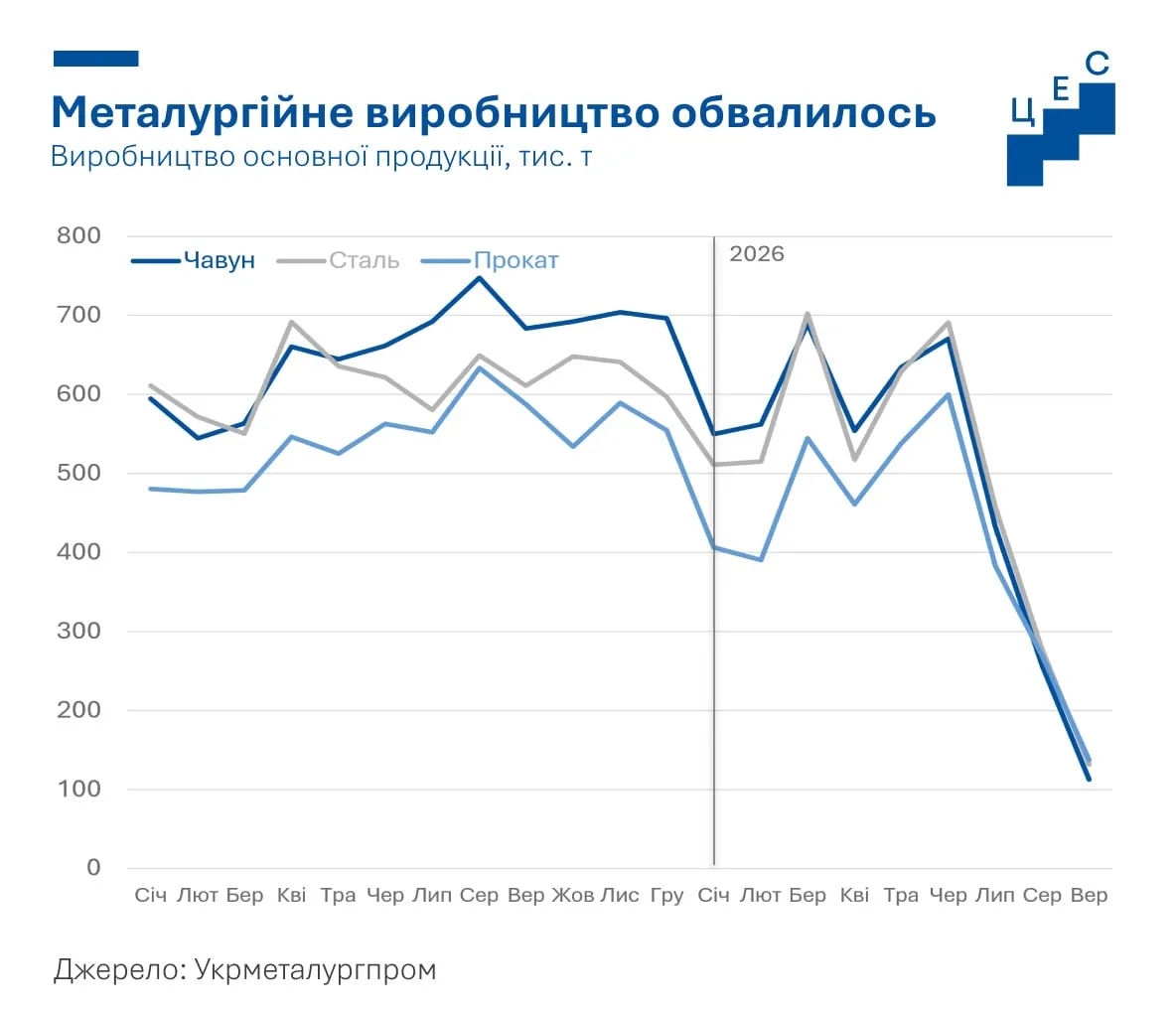
Until 2013 metallurgy supplied about a third of goods exports. After the loss of the Mariupol plants its share fell to 11%, CES says. Agricultural products now make up about 60% of exports.
Port blockade cut summer exports
CES says a blockade of Ukrainian ports hit exports in summer 2026. In August, exports of grain and oilseeds halved. Metals exports fell 48% year on year in value terms. The source gives no further details on the blockade.
Danube ports and the western land borders are partly offsetting the losses, CES says. This logistics is more expensive, and its capacity is limited.
Services hold up better
Services exports have proved more resilient than goods, according to CES. IT services account for 42% of service exports, and the US is the largest market for them, at 37%.
Transport services make up 15%. They lost the income from transit of Russian gas but are supported by growing freight traffic to the EU. The August port blockade cut exports of maritime transport services by more than half, CES says.
Energy emerges as an export
CES calls energy a new export earner despite Russian attacks on Ukraine's power system. In the first nine months of 2026, Ukraine exported 1.35 TWh of electricity to the EU, more than in 2023 and 2024 combined. In August, Romania bought Ukrainian electricity on an emergency basis to cover its own shortfall.
From October, the government also allowed exports of surplus gas. CES says the surplus stems not only from war damage but also from growing production.
Where growth could come from
CES sees the best prospects in processed farm products, energy and machine building. That includes weapons, whose export has now been permitted. RealUA has reported that parliament approved in first reading bill No. 15400, which would send export-control permit fees for military and dual-use goods to the Defence Ministry.
A separate survey for the Business Ombudsman Council, also reported by RealUA, found 61.1% of 319 Ukrainian companies already export to the EU. The most-cited barrier was cost, named by 45.5%.