Survey: 61% of Ukrainian firms export to EU, but costs and certification hold others back
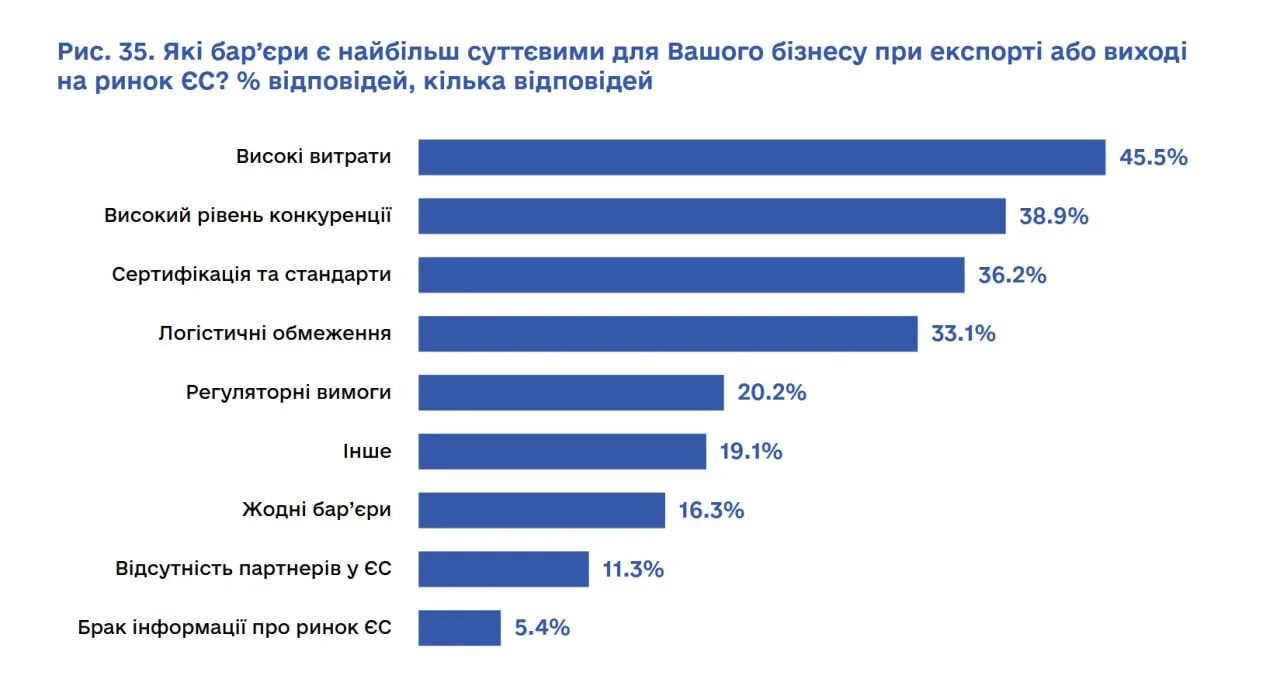
A survey of 319 Ukrainian companies for the Business Ombudsman Council found 61.1% already export to the EU. High costs are the top barrier, cited by 45.5%, followed by sector-specific problems with certification and border logistics.
More than six in ten Ukrainian companies surveyed for a new study already sell to EU countries, but high costs, expensive certification and border delays still hold back wider expansion, according to research commissioned by the Business Ombudsman Council.
The study, "Current Challenges of Business and Investment Attractiveness of Ukraine", was carried out by the Institute for Economic Research and Policy Consulting (IER) in May–June 2026. The Business Ombudsman Council is the state body that handles complaints from businesses about government agencies. The findings were summarised on 14 October by the Telegram channel Economy of Ukraine (@ukreconomic), which also linked the full report.
Who was surveyed
The sample covered 319 enterprises in 20 regions of Ukraine, from micro to large businesses. Of these, 81.5% were fully Ukrainian-owned and 16% were fully foreign-owned or had mixed ownership. The results reflect the views of these firms and should not be read as representative of the whole Ukrainian economy.
Exports already common
According to the survey, 61.1% of the companies already export to EU countries, and about a tenth have clear plans to start. The channel's summary says a lack of information is no longer an obstacle and that entrepreneurs understand the rules of the EU market.
High costs the main barrier
The most common obstacle to entering the EU market was high costs, including product adaptation, marketing and logistics. They were named by 45.5% of businesses. Light industry and food producers feel the financial pressure most, the summary says.
Other problems differ by sector:
- Woodworking and food industries: tough competition from European producers.
- Metallurgy (58.8%) and chemicals (41.7%): complex and expensive certification to EU standards.
- Machine-building (50%) and building materials (64.3%): logistics jams and border delays.
Criticism of official communication
A majority of respondents, 51.7%, consider the state's communication on European integration insufficient. The reason given is a shortage of practical explanations. Almost a third of companies said they lack clear information on how new EU rules affect their specific sector and business processes.
What exporters want from the government
Respondents were asked what support they expect from the state. The most frequent answers were:
- direct funding and grants for adaptation to EU requirements (53.3%);
- development of border infrastructure (39.0%);
- help with certification (39.0%).
The summary does not give the exact wording of the survey questions, whether respondents could choose several answers, or how the sample was selected. Those details would be in the full IER report, which RealUA has not independently reviewed. The percentages are as reported by the channel.