Ukraine's military intelligence lists 37 foreign components in Russia's Kometa modules
HUR has added to its War&Sanctions portal 37 foreign electronic components, 28 companies and 13 pieces of foreign equipment tied to Russia's jam-resistant Kometa navigation modules. The data are HUR's own claims.
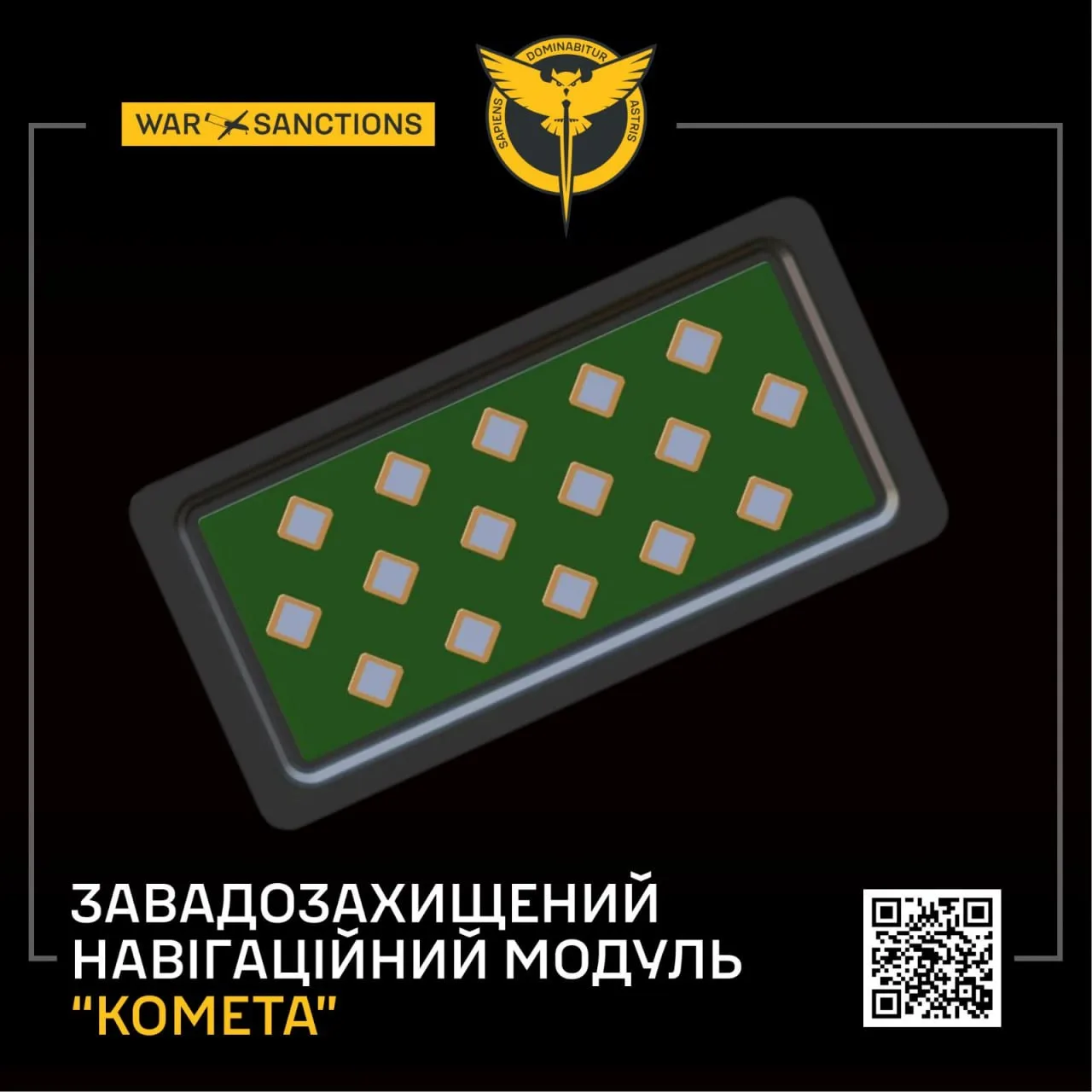
Ukraine's military intelligence agency (HUR) says it has published a list of 37 foreign-made electronic components used in Russia's jam-resistant Kometa navigation modules, along with details of the companies and machinery behind them.
In a post on its official Telegram channel on 19 October, HUR said the data were added to the "Components in Weapons" section of its War&Sanctions portal. The portal is HUR's public database of foreign parts found in Russian weapons, and it is aimed at supporting sanctions enforcement. The post said the new material includes:
- 37 foreign-made electronic components used to build Kometa modules;
- 28 enterprises involved in making Kometa units and supplying the electronic components for them;
- 13 units of foreign production equipment used in manufacturing them.
The post that RealUA reviewed was a short summary with a link to the full report. The lists themselves, including the names of the components, companies and countries, were not in the text, and RealUA has not independently verified HUR's claims.
What Kometa does
Kometa is a navigation module that helps a weapon keep track of its position when Russian or Ukrainian electronic warfare (EW) is trying to jam its signals. HUR says the "classic" Kometa is used in modern Russian missiles, drones and guided aerial bombs.
According to HUR, Kometa relies on a controlled reception pattern antenna, or CRPA. This is an antenna array that can change its reception pattern and use signal-analysis algorithms to "cut out" interference coming from a particular direction. HUR describes this as one of the ways to protect onboard systems from EW.
The agency says the classic Kometa has two main parts:
- an antenna array made up of a set number of patch antennas, which are flat antenna elements;
- a signal-processing module built around an Altera Cyclone FPGA. An FPGA is a field-programmable gate array, a chip whose logic can be reconfigured for specific tasks. HUR describes Altera as a subsidiary of Intel.
HUR says how well the system resists jamming depends on how many patch antennas there are, where they are placed, and the algorithm the FPGA uses to separate the useful signal from interference. Having several antennas lets the module work out the direction that jamming is coming from and compensate for it.
Larger arrays
HUR says Russia is already using Kometa modules with 16 patch antennas on a mass scale, and is working to set up serial production of 20-element arrays. The agency also says it has established that Russia is using a 32-antenna CRPA described as being of "Chinese-Alabuga" production. The post does not explain the term. Alabuga is a Russian special economic zone in Tatarstan that is widely reported to host production of Shahed-type attack drones, which Russia calls Geran. HUR did not say in the post whether this refers to a specific product or factory.
RealUA has not independently confirmed these figures or the deployment claims.
Why it matters
Jamming of satellite navigation is a central part of the electronic warfare battle in the war, and antennas that filter out interference make long-range missiles, drones and glide bombs harder to disrupt. By naming foreign parts and suppliers, Kyiv is trying to give governments and manufacturers information they can use to tighten export controls and track down sanctions evasion. Ukraine has repeatedly argued that Russian weapons depend on imported Western electronics.
RealUA had no earlier coverage of Kometa. This article will be updated if HUR's full lists or any reaction from the companies concerned become available.