Ukraine's steel output collapses 80% after strikes on blast furnaces
A think tank says September metallurgical output fell 80% after Russian strikes on seven blast furnaces. Kyiv also limited new demining near the front, and military intelligence made unverified claims about Russian arms supply and Africa.
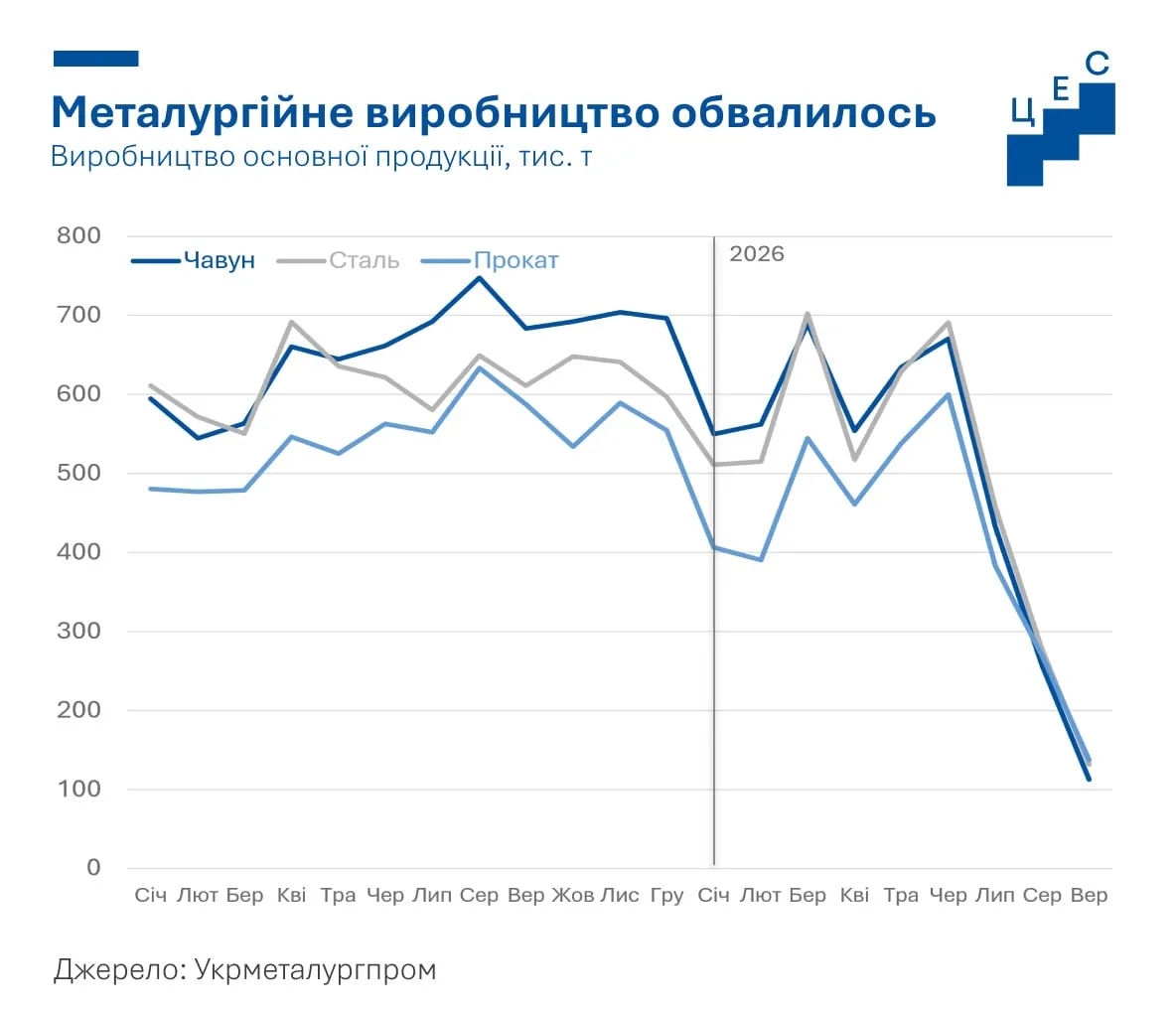
Ukraine's economy took the heaviest news today: a Kyiv think tank says steel output has almost collapsed after Russian strikes on blast furnaces. Elsewhere, the Defence Ministry limited new demining near the front, and military intelligence (HUR) made two claims about Russia that it did not back with evidence.
Steel industry largely idled
Ukraine's metallurgical output fell 80% year on year in September, according to the Centre for Economic Strategy (CES). It says Russian strikes hit seven blast furnaces, five at Metinvest and two at ArcelorMittal Kryvyi Rih. Those plants made about 90% of the country's steel, and CES says they do not plan to restart during the war. Metallurgy with related industries gave more than 5% of GDP last year, and Dragon Capital puts the losses from the steel stoppage and lower ore mining at 1.5% of GDP. The figures are CES's own and could not be independently verified, and the companies' own damage assessments were not available.
Demining curbed near the front
The Defence Ministry says planning of new humanitarian demining is restricted at some sites in six regions: Donetsk, Dnipropetrovsk, Kherson, Mykolaiv, Kharkiv and Sumy. The sites lie 20–50 km from the front line and the Russian border. The ministry says this is not a halt. Work already under way is to be finished if conditions allow, and emergency work, such as that needed for evacuations and rescue, takes priority. The ministry did not say how many sites are affected or when the rule takes effect. It said it will review the decision as the security situation changes.
HUR on foreign machines in Russian missiles
HUR published data on 30 foreign-made machine tools and measuring devices that it says Russian factories use to build ballistic missiles. It says they come from China, Germany, Taiwan, the United States, Turkey, Switzerland and Italy. The agency released no supporting evidence, so the claim is unverified. The entries were added to its War&Sanctions portal.
HUR on Russia's Africa plans
Ahead of the Russia–Africa summit on 28–29 October, HUR says Moscow is seeking military agreements and naval access. It names Benin and Senegal for military cooperation papers, and several other states for easier port calls by Russian ships. It also names Port Sudan, Berbera and Assab as possible logistics points. HUR gave no evidence, and neither Russia nor the African governments named have commented.
From the editor's desk
The steel story is the one I would not let slide. Ports and air defence get the attention, but a country that loses most of its steel loses jobs, exports and budget revenue, and that cost shows up slowly in statistics like these. I also note that two of today's four items rest on HUR's word alone. They may well prove right, but I will wait to see what the summit in fact produces. I will also watch whether the demining restriction gets a list of sites, since farmers and rescuers will want to know where it applies.