Flash: Russia expands satellite jamming of Starlink, now covering Crimea
Ukrainian communications expert Serhii "Flash" Beskrestnov says Russia is adding satellite electronic-warfare systems that jam Starlink, covering almost all key sites in Crimea. The claims are unverified.
Russia keeps increasing the number of satellite electronic-warfare (EW) systems that interfere with Starlink, according to Serhii "Flash" Beskrestnov, a Ukrainian communications and drone expert. He said Russian forces have covered almost all important sites in Crimea and are using the systems more often along the front line. The claims come from his Telegram channel and have not been independently verified.
How the system works
Beskrestnov said the system provides "point" or site cover: it protects an object, such as a base or a command post, across an area of roughly 25 square kilometres. In plain terms, it jams the radio link between Starlink terminals on the ground and the satellites overhead within that zone.
He said the jammer operates in the 14.0–14.5 GHz band. Starlink user terminals transmit to satellites in the Ku band, so jamming there targets the uplink. That link is how a terminal sends data, including drone video and control signals, back to the network.
According to Beskrestnov, the core of the complex is satellite dishes of the "prime-focus" type, about one metre in diameter. A prime-focus dish has its receiver or feed placed directly in front of the reflector rather than offset from it.
Camouflage, and its limits
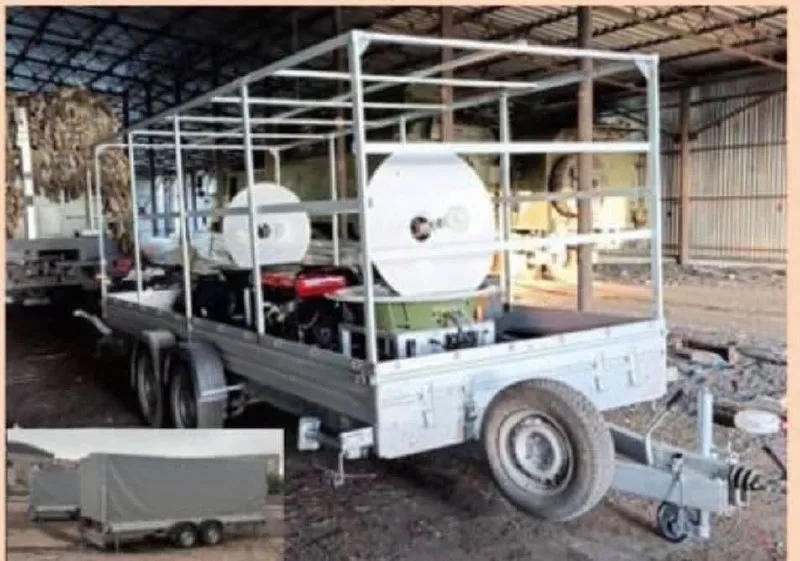
Beskrestnov said the days when the complex looked like six trailers parked side by side on one site are long gone. The enemy now tries to disguise it. But the dishes need an unobstructed view of the zenith, the point directly overhead, so any camouflage has limits.
He gave aerial reconnaissance units, who he said regularly ask him what to look for, these pointers:
- Truck parking areas. He called them an ideal place to hide the system: among dozens of lorries, perhaps three to six could carry it.
- Small car trailers. He said Russia has devised a variant with one antenna instead of two, in small trailers that stand near each other but are spread across the terrain.
- Covers. Camouflage netting in the rear would draw attention at once, so he considers it unlikely. The system can work under a polycarbonate canopy or under plastic film, so he advised watching for opaque greenhouses.
He also dismissed a common assumption. Many people write that the system consumes huge amounts of power and must be placed near power substations. "This is not so," he said: the complex can run even from generators.
Background
Starlink, SpaceX's satellite internet service, has become central to Ukrainian military communications, including drone control and data links. RealUA has covered the dependence in recent weeks, including a speed cap on moving terminals that Beskrestnov and others said hit missions and interceptor drones, and a Ukrainian weapons maker's claim that it can strike without Starlink. Zelensky later said that the Starlink and Starshield limits had been lifted.
Beskrestnov is a well-known figure in Ukrainian military tech circles, and he frequently comments on Russian EW and drone developments. This post is a single-source expert assessment. He did not name locations, give the number of systems deployed or publish evidence of specific sites, and Russian officials have not commented on it. It is also not clear from his post how far the jamming has degraded Starlink in practice.