Russia imported nearly 1 million tonnes of fuel by sea in three months, Ukrainian intelligence says
Ukraine's military intelligence (HUR) says 39 shipments on 30 tankers delivered about 989,000 tonnes of fuel to Russia between 18 July and 22 October 2026, mostly gasoline. The figures are HUR's own claims.
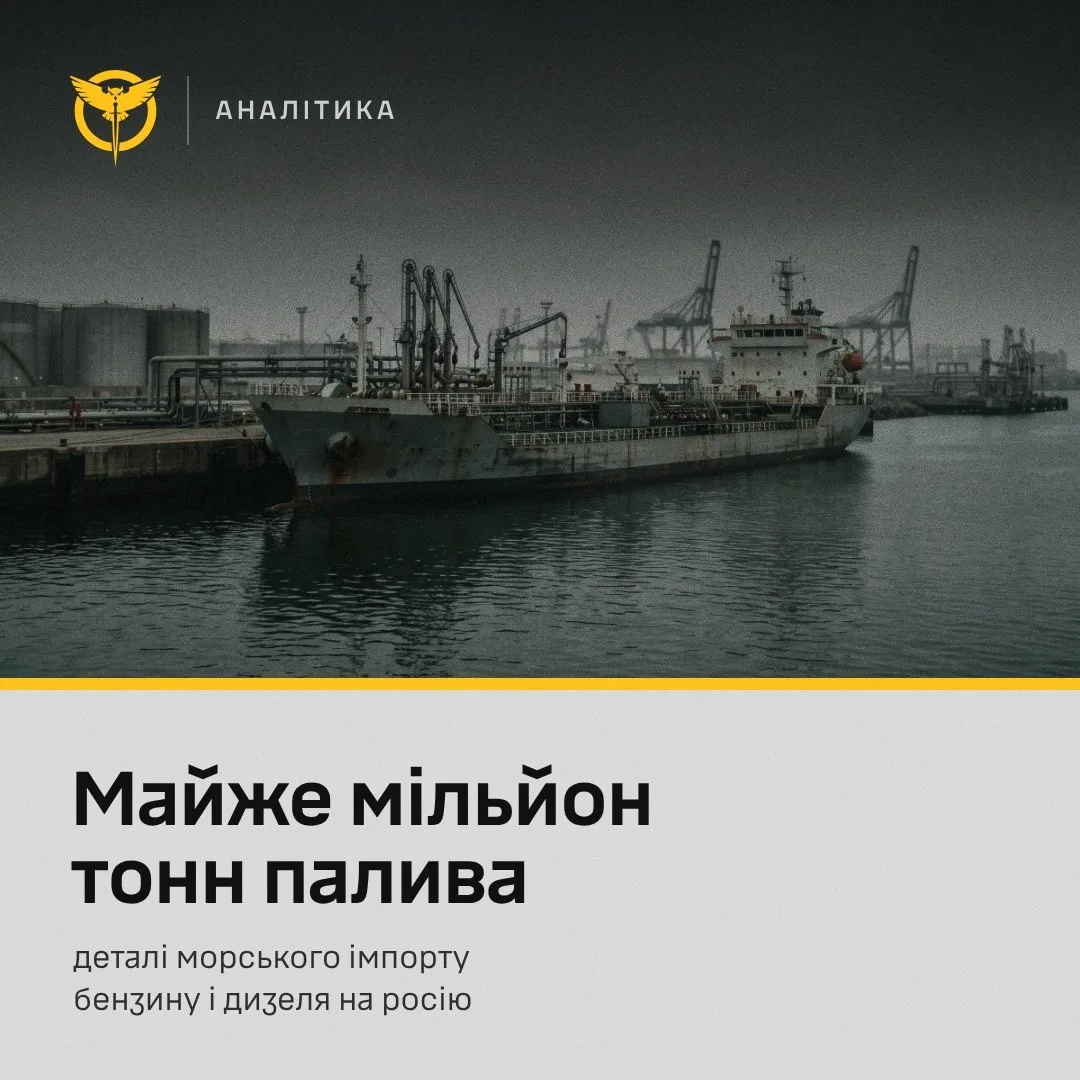
Russia received about 989,000 tonnes of fuel by sea between 18 July and 22 October 2026, according to Ukraine's military intelligence service (HUR). It says the imports are a response to domestic shortages caused by Ukrainian long-range strikes. HUR published the figures on 17 November. They are the agency's own claims, and RealUA could not independently verify them.
HUR says 39 shipments of fuel and high-octane additives arrived on 30 tankers over the three-month period.
What was delivered
Gasoline made up most of the volume, according to HUR:
- Gasoline: 724,200 tonnes (73.2%)
- Diesel: 128,100 tonnes (13.0%)
- Jet A-1 aviation fuel: 106,700 tonnes (10.8%)
- MTBE high-octane additives: 30,000 tonnes (3.0%)
MTBE is a compound blended into gasoline to raise its octane rating.
Where it went
Ports in north-western Russia took the largest share, 42.3%. HUR names Vitino (Kandalaksha) and Murmansk. Baltic ports, Vysotsk and St Petersburg, received 32.8%. Another 24.0% went to Vladivostok and Nakhodka in the Far East, and 0.9% to Astrakhan.
HUR calls Vitino and Vysotsk the key entry points. It says 15 shipments totalling 573,000 tonnes (58% of the total) went to those two ports. It adds that 79% of the imported gasoline was unloaded there.
Tankers and sanctions
Of the 30 vessels involved, HUR says 13 are under sanctions from the EU, the UK, the US or other partner countries. Two more, HANNA (IMO 9397456) and CAPIBARA (IMO 9267027), are sanctioned only by Ukraine.
The remaining 15 are not under any sanctions, according to HUR. It lists them by name and IMO number:
- ARAM KHACHATURIAN (9163752)
- PEGAS (9163776)
- ZALIV ANIVA (8802806)
- ANNA (9829069)
- HALIA (9174608)
- IVY PEARL (9252448)
- RARITY (9278519)
- PHOSPHOR (9354179)
- SINO FAITH (9375575)
- SINO PROSPERITY (9328132)
- AURORA (9258351)
- TULU (9313462)
- DERIN (9290646)
- ANTEY (9353137)
- CHEM NIKOLAS (9374416)
Ship-to-ship transfers
Some of the fuel did not travel directly to Russia. HUR says at least 216,000 tonnes of petroleum products (22% of the total) were moved between ships at sea in five shipments. The tanker GARNET made two of those voyages, and TALISMAN, BEAST and CHEM NIKOLAS made one each.
HUR says these transfers took place at sea off the Egyptian ports of Damietta and Port Said, and near the Spanish port of Ceuta. The agency did not say who owned or chartered the cargoes, where the fuel originated, or whether any port or flag state authorities were aware of the transfers.
Background
Ukraine has targeted Russian oil refineries throughout the war. Earlier RealUA coverage reported that Ukraine's Defence Ministry said its forces struck 12 large Russian refineries in September 2026, also an unverified official claim. In October, President Volodymyr Zelensky said Ukraine had lifted a pause on refinery strikes after three days, a pause made at Washington's request. Separately, Donald Trump announced an energy ceasefire in October, and Moscow had not confirmed it.
The HUR report also appears against a backdrop of shifting sanctions policy. RealUA has reported that US President Trump allowed Russian diesel imports, a decision seven US senators said breaks a 2022 congressional ban. It also reported that Russian Deputy Prime Minister Alexander Novak said diesel exports could return to 3–3.5 million tonnes a month by the end of 2026.
HUR's post does not give a total for Russian fuel consumption or production. It also does not say how much of the shortfall these imports covered, so the figures cannot show how large Russia's shortage is. They show only the sea-borne share of fuel imports that HUR says it tracked.